
Wolf Lake Indiana Thesis (Hammond, IN)
The Bears' stadium saga has been one of the longest-running soap operas in professional sports

In February 2026, the Indiana House Ways and Means Committee voted 24-0 to advance Senate Bill 27, naming Hammond as the designated site for a potential new Chicago Bears NFL stadium near Wolf Lake. The Bears responded with a statement calling it “the most meaningful step forward in our stadium planning efforts to date” and committed to continuing site due diligence for the Wolf Lake area. The Indiana General Assembly passed the bill. Governor Mike Braun signed it. A Northwest Indiana Stadium Authority was created, empowered to issue bonds, acquire land, and finance construction.
And as of this writing, the median home price in Hammond, Indiana is roughly $160,000 to $199,000.
First, the Backstory: How Hammond Got Here
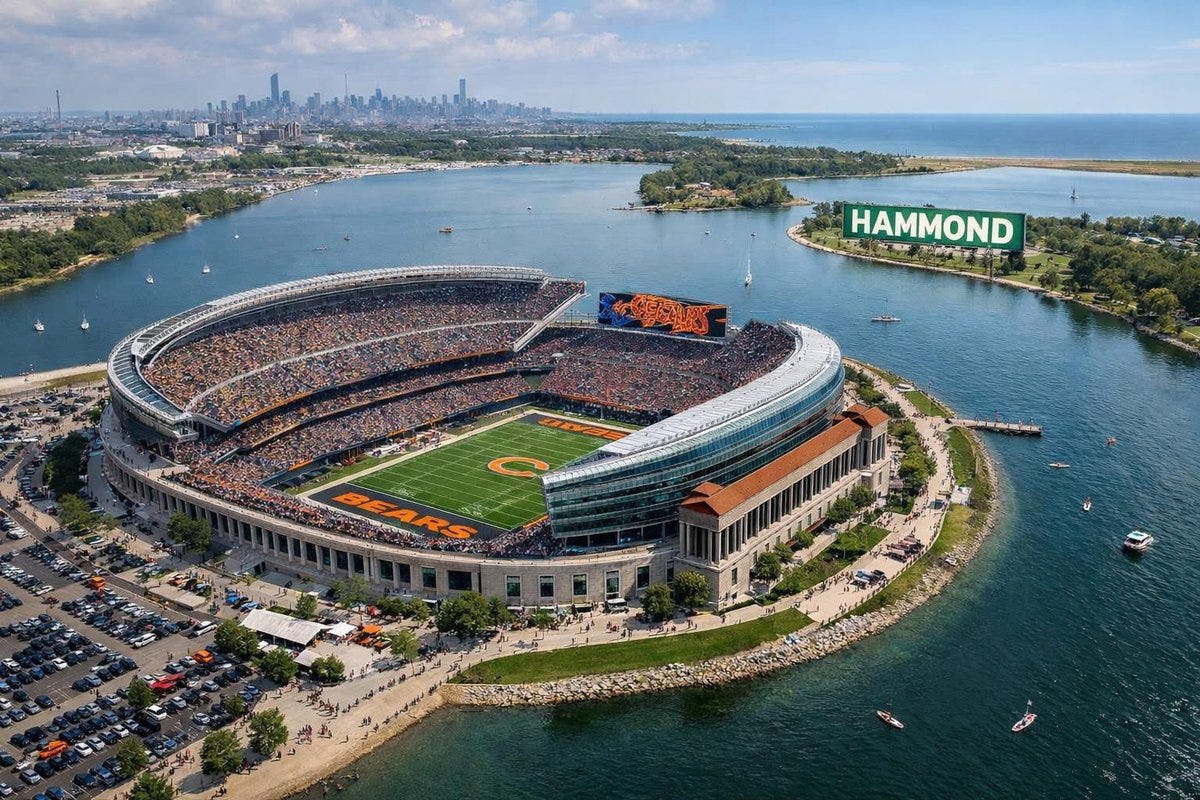
The Bears’ stadium saga has been one of the longest-running soap operas in professional sports - a decade-plus negotiation involving multiple cities, multiple governors, multiple mayors, and a franchise worth north of $5 billion that seemed perpetually unable to finalize where it wanted to play football.
The short version: the Bears have played at Soldier Field in Chicago since 1971. The stadium, owned by the city, underwent a contentious $632 million renovation in 2003, saddling it with hundreds of millions in remaining debt. The Bears have a lease through 2033. For years, it was assumed they’d simply stay, renegotiate, and eventually get a new deal done.
Then the calculus changed. In 2021, the Bears signed a purchase agreement for Arlington Park, the former horse racing track in suburban Arlington Heights, and finalized the $197 million acquisition in 2023. They announced a jaw-dropping $5 billion mixed-use development plan - stadium, retail, restaurants, housing - and it looked like the deal of the century for Arlington Heights. But Illinois state legislators balked at the property tax concessions the Bears needed, and negotiations dragged on for years without resolution.
By late 2025, the Bears had pivoted multiple times - considering the Museum Campus lakefront, the former Michael Reese Hospital site, back to Arlington Heights - cycling through sites like a buyer who can’t commit. Then, in December 2025, the team began seriously exploring Indiana, visiting Hammond among other Northwest Indiana sites with NFL Commissioner Roger Goodell during the team’s playoff run.
What happened in February 2026 was not a surprise to anyone watching closely. Indiana had been building its case methodically: passing enabling legislation, coordinating between the state government, the Legislature, and Hammond’s mayor, and presenting a unified front that Illinois - with its fractious Springfield politics - simply couldn’t match. When Indiana’s Ways and Means Committee voted unanimously and the Bears issued their statement, it had the feeling of a deal being done in public before the paperwork was signed.
Hammond Mayor Thomas McDermott, a six-term incumbent who has presided over a decade of incremental city revival, was ebullient. “This is a once-in-a-generation opportunity,” he told the committee. “Hammond is ready to partner with the State of Indiana, the Chicago Bears, and will do whatever it takes to make this project a success.”
Indiana House Speaker Todd Huston put it simply: “I think we found a great partner in the Chicago Bears. Today is a historic day, one we look forward to building upon.”
The Bears committed $2 billion in private funding toward stadium construction. The state agreed to contribute $1 billion in public funding, financed through a 1% food and beverage tax in Lake and Porter counties, a doubling of the hotel tax in Lake County, a 12% admissions tax on stadium events, and an increase in Indiana toll revenues. The framework, while not final, is more concrete than anything that has materialized in Illinois after three years of negotiations.
Hammond, Indiana: What You’re Actually Looking At
Hammond is a city of approximately 77,000 people in Lake County, Indiana, directly on the Illinois state line at the southern shore of Lake Michigan. It is, functionally, a part of Chicagoland - residents listen to Chicago radio, root for Chicago teams, and many commute into the city via the South Shore Line commuter rail, which connects Hammond to Millennium Station in downtown Chicago’s Loop in roughly 35 minutes.
The city was once a major industrial center - meatpacking, steel, manufacturing - and carries the physical and economic scars of deindustrialization that defined the Rust Belt’s decline from the 1970s through the 1990s. Per capita incomes remain below national averages. The school district has faced challenges. Parts of the city show the wear of decades of disinvestment. None of this should be papered over.
But Hammond has been in a quiet recovery for roughly a decade. Mayor McDermott’s administration has pursued a deliberate revitalization strategy, including downtown redevelopment, park improvements, and economic development initiatives. The Horseshoe Hammond Casino is a significant employer and draws visitors. Purdue University Northwest has a campus in Hammond, anchoring an educational and research presence. Wolf Lake Memorial Park - the body of water at the center of the stadium discussion - hosts the annual Festival of the Lakes and is one of the most genuinely scenic public spaces in Northwest Indiana, straddling the Illinois-Indiana state line with a surprisingly serene atmosphere given its industrial surroundings.
The housing market reflects both the opportunity and the starting point. Zillow puts the typical Hammond home value at approximately $159,870, up modestly over the past year. Listing data from late 2025 showed a median asking price around $199,000. Homes sell in roughly 45 to 57 days - fast by any standard for a market at this price point. The city is not stagnant; it’s been appreciating. But it is appreciating from a base so low that the upside math on a stadium announcement is, frankly, striking.
The Investment Thesis: Where Exactly the Upside Lives
The NFL Team Relocation Effect
Research on NFL team relocations shows a consistent pattern: properties in the receiving city’s stadium zone outperform the broader market. A study tracking the Raiders’ move to Las Vegas found that median residential property values near the new stadium site in the Whitney neighborhood rose 19.3% in the year following the relocation announcement, compared to 16.3% for Las Vegas overall - still a meaningful premium at a time of broad market appreciation. Research aggregating multiple relocations found NFL team arrivals associated with roughly 4.9% appreciation above the national average for properties in the impact zone.
The broader commercial real estate data is even more compelling. Near Levi’s Stadium in Santa Clara, retail space commands a 40% premium over the rest of the city. The Houston market around NRG Stadium has seen retail rents approach $34 per square foot and apartment rents exceeding $1,600 per unit - premiums of 40% and 20% above market averages, respectively. A broader dataset shows that new NFL stadiums are associated with a 15% boost in business formation within a five-mile radius in the first five years.
Now apply those frameworks to Hammond’s starting point: median home values around $160,000 to $200,000 in a city that sits 18 miles from downtown Chicago and has direct rail access to the Loop.
A 15% to 20% appreciation premium on Hammond’s current median brings homes in the impact zone to roughly $185,000 to $240,000. But that almost certainly understates the real opportunity, for reasons we’ll get to. And in commercial real estate - hospitality, retail, mixed-use - the story is potentially much larger.
The Undervaluation Gap
Here is the core investment insight that most commentary on this situation misses: Hammond is already undervalued relative to its proximity to Chicago, entirely aside from the Bears.
Communities with direct commuter rail access to downtown Chicago - 35 minutes on the South Shore Line - do not typically have median home values under $200,000. Comparable transit-connected suburbs on the Illinois side of the metro trade at two to four times Hammond’s price points. Wilmette. Evanston. Oak Park. Even farther-out communities like Joliet and Aurora, which lack Hammond’s direct non-stop rail link, carry higher median prices.
The discount exists for real reasons - Hammond’s industrial history, its school district performance, its demographics, its location in Indiana rather than Illinois (which carries different psychological weight for many buyers). Those aren’t imaginary factors, and a responsible investor has to account for them.
But they also create a compression spring. Hammond is priced like a distressed city that doesn’t have the fundamentals of a distressed city. It has a South Shore Line station. It has a functioning commercial casino. It has a major university. It has a mayor who has been executing a revival strategy for over a decade. It has Lake Michigan on its doorstep and a conservation lake at its center. And it sits in a state - Indiana - that has consistently ranked among the most business-friendly in the country, with low regulatory friction and a governor who just personally championed bringing the NFL to his state.
Add an NFL stadium and a $2 billion private investment commitment to that picture, and the undervaluation gap doesn’t just close - it potentially inverts.
Specific Investment Zones and Their Upside
Not all Hammond real estate carries equal exposure to the Bears catalyst. Here’s how to think about the geography:
The Wolf Lake Corridor (Highest Upside, Highest Uncertainty)
The primary stadium site being evaluated is near Lost Marsh Golf Course at 129th Street and Calumet Avenue - within walking distance of Wolf Lake itself. Properties within a mile to two miles of the eventual stadium footprint carry the most direct exposure to both the construction boom and the long-term event economy. Commercial land and developable parcels in this zone are the highest-conviction play if the stadium is confirmed.
The challenge: this is also an area with genuine complications. The Lost Marsh Golf Course was built over an old industrial landfill - environmental due diligence on any nearby property is non-negotiable, not optional. The neighborhood currently abuts an oil refinery and existing residential streets that weren’t designed to accommodate 60,000-plus game-day attendees. Significant infrastructure investment will precede and accompany the stadium. During that transition, holding through disruption requires patience and capital.
The upside: commercial properties within two miles of a major NFL stadium in markets ranging from Houston to Santa Clara have shown 30% to 40% valuation premiums over metropolitan averages. In a market where the current baseline is this low, that premium is measured in multiples of the purchase price - not percentages.
The South Shore Line Corridor (Moderate Upside, More Liquidity)
The South Shore Line connects Hammond directly to Chicago, and the station zones - already the highest-demand residential areas in the city - will be the primary beneficiary of any stadium-driven population influx. Workers, vendors, hospitality employees, and commuter-oriented residents priced out of Chicago will look first to transit-connected Hammond neighborhoods.
Residential properties within walking distance of the Hammond South Shore station currently list in the $150,000 to $250,000 range. In a scenario where Hammond becomes the NFL’s host city, the realistic comparable set for this housing shifts from “distressed industrial suburb” to “transit-connected game-day destination with Chicago access.” That re-rating carries the potential for 40% to 80% appreciation over a five-to-seven year holding period, depending on how aggressively the broader development follows the stadium.
Hospitality and Commercial Corridors
This is where the most explicit stadium math applies. A new NFL stadium in Hammond will need hotels - there are essentially none in the immediate Wolf Lake area currently. It will need restaurants, bars, sports merchandise retail, and entertainment venues. The land on which those establishments will be built is trading today at prices that reflect Hammond’s current economy, not the economy it would have with 8+ NFL home game weekends per year, plus concerts, trade shows, and major events at an enclosed, all-weather facility.
For context: the Bears’ proposed facility would be an enclosed dome capable of hosting Super Bowls, Final Fours, and major concerts - the same event categories that have driven Allegiant Stadium in Las Vegas and SoFi Stadium in Inglewood to become year-round economic engines far beyond their NFL schedules. An enclosed stadium in the Chicago market - the third-largest metropolitan area in the United States - would compete for the most lucrative events on the global sports and entertainment calendar.
Commercial land adjacent to that development, bought at current Hammond prices, represents one of the most asymmetric opportunities in Midwest real estate.
The Inglewood Lesson: What Happens When a Depressed Suburb Gets an NFL Stadium
The closest historical analog to Hammond’s situation is Inglewood, California, before and after SoFi Stadium was built for the Rams and Chargers.
Inglewood was a city with a complicated history - disinvestment, crime, underperforming schools, a distinct image problem relative to the gleaming Westside neighborhoods it bordered. Home prices lagged Los Angeles averages significantly. The Forum arena was its main economic anchor, and even that had largely sat dormant.
Then the NFL returned to LA and chose Inglewood. Between 2015 and 2020, home prices in the neighborhoods around SoFi Stadium rose approximately 66% - outperforming the already-hot Los Angeles market by a substantial margin. The city attracted hotel investment, restaurant development, retail, and eventually, residential development targeted at a completely different demographic than had historically lived there. It didn’t become Beverly Hills. But it stopped being the Inglewood it had been, and property owners who bought before the stadium was confirmed made life-changing returns.
Hammond is not Inglewood. The Chicago market is not Los Angeles. But the structural dynamics are similar: an underpriced urban community adjacent to a massive metropolitan area, where a single catalytic development has the potential to rerate the entire investment environment.
The difference that matters most for the investor: Inglewood’s opportunity became obvious only after the Rams committed. Hammond’s window is open right now, before the deal is done.
The Honest Risk Register
This article would be irresponsible without a frank accounting of what could go wrong. There are real risks here, and several of them are substantial.
The Deal May Not Close
This is the paramount risk and it deserves to be stated plainly. The Bears stadium saga has now spanned multiple cities and multiple years, with multiple apparent near-finales that didn’t materialize. Illinois is still in the game - the Illinois General Assembly’s session runs through May 2026, giving Springfield months to construct a competing offer. Governor Pritzker has made clear he wants the Bears to stay. Arlington Heights is still a viable site. The Bears own 326 acres there.
Indiana’s framework is the most advanced concrete legislative package on the table. The Bears’ statement was the most direct they have been about any site’s primacy. But they have not signed a lease, bought land, or broken ground. Until one of those things happens, the deal is not done, and investors who assume otherwise are taking on binary deal-closing risk.
Environmental Complexity
The Lost Marsh Golf Course site was built over an industrial landfill. Northwest Indiana more broadly has a legacy of heavy industrial activity, and environmental due diligence in this region is not a formality - it is a substantive undertaking. Investors buying land near the proposed stadium site without thorough Phase I and Phase II environmental assessments are not investing; they are speculating on clean soil.
Infrastructure and Gentrification Friction
A sudden influx of development investment into a working-class city creates real social friction. Hammond’s existing residents - many of whom have held on through decades of disinvestment - will face rising property taxes and rental costs that not everyone can absorb. This is not a theoretical concern; it is the consistent documented experience of stadium-adjacent communities from Atlanta to Seattle. Investors should be clear-eyed about what they are participating in and should account for the political and regulatory responses that often follow rapid gentrification - rent stabilization discussions, rezoning disputes, community benefit agreement requirements.
The Suburb vs. Downtown Divide in Stadium Economics
Academic research on NFL stadiums offers a genuinely mixed verdict. Trulia’s analysis found that while neighborhoods near existing NFL stadiums generally have higher-than-average home values, newly built stadiums have in many cases failed to lift immediately adjacent property values - particularly when built in suburban or semi-rural contexts. AT&T Stadium in Arlington, Texas did not dramatically lift surrounding property values in the years after it opened. Lucas Oil Stadium in Indianapolis saw nearby neighborhoods underperform the broader Indianapolis market.
The key variable appears to be whether the stadium is embedded in a walkable, mixed-use urban environment or surrounded by parking lots and highways. The Wolf Lake site in Hammond is currently closer to the latter than the former. The investment thesis depends critically on the development around the stadium being properly planned, permitted, and built - not just the stadium itself.
Timing Uncertainty
Even in the optimistic scenario where the Bears commit to Hammond and ground is broken, major NFL stadium construction takes five to seven years to complete. The Bears’ lease at Soldier Field runs through 2033. Development timelines in this asset class are long. Investors need to model holding periods of five to ten years minimum to capture the full value creation cycle - and that’s assuming no construction delays, environmental remediation complications, or political reversals along the way.
What Smart Positioning Looks Like Right Now
Residential Near Transit Is the Lowest-Risk Entry
For investors who want exposure to the Hammond catalyst without taking on the full binary risk of the stadium deal closing exactly as planned, residential properties near the South Shore Line in Hammond’s most stable neighborhoods represent a more conservative entry point. You’re buying transit-connected Chicagoland real estate at prices that don’t reflect transit access. If the Bears come, these properties rerate sharply. If the Bears don’t come, you’re still holding affordable residential real estate in a recovering city with legitimate fundamentals. The floor is higher here than in the Wolf Lake corridor.
Commercial Land Is the High-Conviction Play for Accredited Investors
For accredited investors with longer time horizons and higher risk tolerance, commercial-zoned land in the Wolf Lake corridor - particularly parcels suitable for hospitality development - represents the highest-upside scenario in Hammond’s investment landscape. You are, in essence, buying a call option on the Bears committing to the site. The premium on that option is the current purchase price of Hammond commercial land. The payoff, in a scenario where an enclosed NFL stadium opens in the Wolf Lake area, is the difference between Hammond commercial land values in 2026 and the values of similar land near a domed, all-weather NFL and entertainment venue in a top-three American metropolitan market.
That gap is very large.
Watch the Legislative Clock
The Indiana General Assembly session ended in late February 2026. Any deal with the Bears that requires additional legislative action in Indiana would need to wait until the next session. The Bears’ Soldier Field lease runs through 2033. This gives both sides time - but it also creates a window where the deal could lose momentum if site due diligence reveals complications at Wolf Lake (environmental issues, soil bearing capacity, utility access) or if Illinois comes back with a dramatically improved offer. Investors should monitor Bears-related news from both states closely throughout 2026.
The Number That Keeps Coming Back to Me
Here is the figure I find myself returning to when I think about Hammond’s investment case.
The three largest metropolitan areas in the United States - New York, Los Angeles, Chicago - all have NFL franchises. New York has two, and their stadium is in New Jersey. Los Angeles has SoFi Stadium in Inglewood. Chicago currently has Soldier Field, aging, city-owned, and the source of franchise discontent for over a decade.
In New York and Los Angeles, the land markets near NFL stadiums - whatever the academic research says about the stadiums’ causal impact - are priced as premium assets in premium metropolitan areas. No one is buying land near SoFi Stadium for under $200,000 per unit. No one is buying in East Rutherford at Hammond prices.
Only in Chicago - the third-largest metropolitan area in the country - is the land market adjacent to a potential NFL stadium site priced at an agricultural Midwestern discount. And that’s only because the team hasn’t committed yet.
When they do, the discount will compress. How far and how fast is the variable. But the direction is not in question.
Hammond has been waiting a long time for something to change the narrative about what it is and what it can become. If the Chicago Bears cross the state line - bringing a $2 billion private investment, a $1 billion public commitment, a Northwest Indiana Stadium Authority with bond-issuing authority, and the concentrated commercial energy of NFL game days and major events - that narrative changes faster than almost any other single catalyst could produce.
The window is open.
Bottom Line: Explicit Upside Estimates
In the spirit of specificity that this subject deserves, here are the investment scenarios with explicit upside framing - stated clearly, without hedging language meant to avoid accountability.
Scenario 1: Bears confirm Hammond, stadium opens by 2031–2032. Residential properties within one mile of Wolf Lake that are purchased today in the $150,000–$250,000 range carry a realistic 5-to-7-year target value of $300,000–$500,000, depending on proximity to the stadium, unit condition, and broader market trends. That is a 2x–3x return on a leveraged residential purchase at current prices. Commercial land suitable for hospitality development, purchased at current Hammond prices and sold to hotel or restaurant developers after the stadium is confirmed, carries even higher potential - 4x to 6x on entry cost in an optimistic scenario, based on comparable land value appreciation near newly opened NFL stadiums in comparable markets.
Scenario 2: Bears delay but ultimately commit by 2028–2030. The upside timeline extends, but the direction holds. Returns compress modestly given the longer holding period and additional capital costs. Residential properties likely deliver 60%–100% appreciation over the extended horizon. Commercial land still delivers 2x–4x in a successful outcome. The cost of the longer wait is opportunity cost and carrying costs, not loss of principal in most scenarios.
Scenario 3: Deal falls apart, Bears go to Arlington Heights or stay in Chicago. Residential properties purchased in Hammond’s stable transit corridors likely retain value and appreciate modestly in line with broader Northwest Indiana market trends - perhaps 2%–5% annually, in line with recent history. Commercial land near Wolf Lake purchased at speculative prices faces the highest downside - a meaningful loss of value is possible if the stadium thesis collapses and the environmental complexity of the site depresses buyer interest. This is the scenario investors must stress-test before committing capital.
The risk-reward asymmetry favors entry for investors who can tolerate a 3-to-5-year holding period and can distinguish between the transit-corridor residential play (lower risk, meaningful upside) and the Wolf Lake commercial play (higher risk, higher upside). The window between “the deal is progressing” and “the deal is done” is historically when the best land prices are available - and that window is open right now.