
The Pico Corridor Thesis (Santa Monica, CA)
When a 192-acre airport becomes a park, state law overrides local zoning, office markets collapse, and retail vacancies spike simultaneously

There’s a certain kind of real estate opportunity that only becomes visible when you read city planning documents the way other people read box scores. It doesn’t appear in the lifestyle press. It doesn’t have a catchy neighborhood rebrand yet. The coffee is still mediocre and the signage is still faded. But the bones are exceptional, the forces in motion are enormous, and the price-to-upside ratio is the most interesting on the Westside.
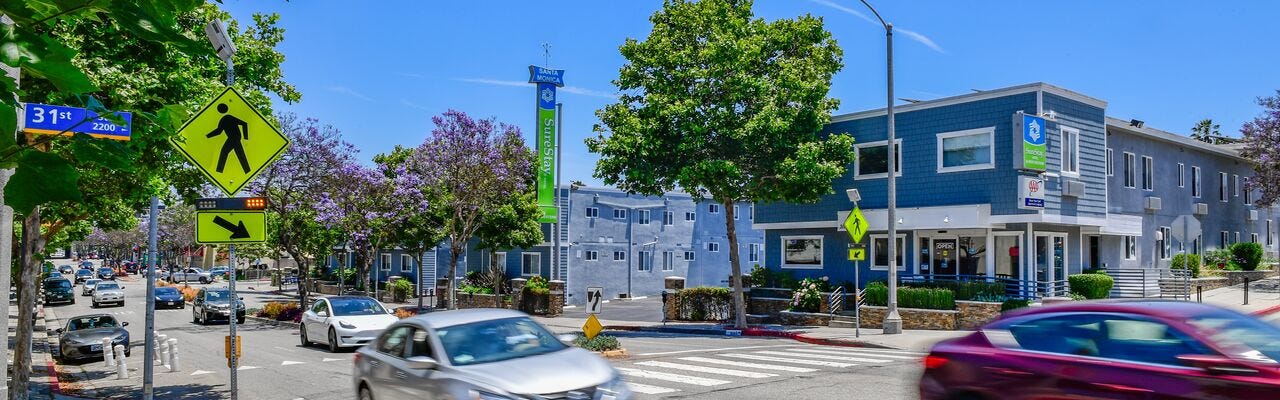
That opportunity runs along Pico Boulevard between Centinela Avenue and 26th Street - a roughly mile-and-a-half stretch of East Santa Monica that sits at the precise convergence of four major urban catalysts, each of which would individually be enough to justify attention. Together, they make this corridor one of the most compelling medium-term investment plays in Los Angeles County.
Let me tell you exactly why.
First, the Geography - Which Is Everything
You can’t assess this corridor without understanding its position on the map, because the position is unusual.
At Centinela Avenue, Pico Boulevard crosses the jurisdictional line from the City of Los Angeles into the City of Santa Monica. It is, in other words, the eastern gateway to one of the most desirable, tightly controlled, and supply-constrained municipalities in the country. The western anchor, at 26th Street, sits a single block from the Metro E Line’s 26th Street/Bergamot Station - the Westside’s most important piece of rail transit infrastructure, connecting this corridor directly to Culver City, USC, and downtown Los Angeles in roughly 40 minutes without touching a freeway.
South of this stretch lies Sunset Park, a mature, family-oriented residential neighborhood of bungalows, tree-lined streets, and $2 million to $4 million single-family homes. North lies Mid-City Santa Monica, denser and more commercial. To the west, the Bergamot Station arts complex - currently being planned for major residential redevelopment - abuts a formerly industrial zone that is actively transforming. And southwest, roughly a half-mile away, sits the 192-acre Santa Monica Airport, which closes to aviation use permanently on December 31, 2028, and converts to what will be one of the largest new urban parks created in Southern California in generations.
This stretch of Pico doesn’t just run through a neighborhood. It runs through the middle of an active transformation, with catalysts pressing from every cardinal direction simultaneously.
Catalyst One: The Great Park - The Most Underappreciated Real Estate Story in Los Angeles
Start with the airport, because its impact is so large and so certain that it almost doesn’t seem real.
The Santa Monica Airport has been a contested fixture of the city since the 1970s, when noise complaints, safety concerns, and community opposition began the decades-long campaign for its closure. The fight concluded in a 2017 agreement with the FAA establishing an irrevocable closure date: December 31, 2028. The City Attorney confirmed in January 2025 that no further council action is needed - the closure is legally locked. The runway has already been shortened to accelerate the wind-down.
What happens to the land after 2028 is now also settled. Measure LC, passed by Santa Monica voters in 2014 with 60% support, codified that the airport land can only be converted to parks, public open space, and recreational facilities unless voters explicitly approve otherwise. The City Council voted in July 2025 for the “Great Park” approach - a design by planning firm Sasaki that envisions 192 acres of trails, athletic fields, event spaces, botanical gardens, and cultural amenities, organized around eight distinct “districts.” Environmental review begins in 2026. Construction is expected to be phased after 2028.
Let that land area sink in. One hundred and ninety-two acres. In Santa Monica. A city that, at current population levels, has only 1.4 acres of parkland per 1,000 residents - far below county, state, and national standards. A city where apartment asking rents average $3,356 per month, nearly double the national average. A city surrounded by the highest-priced residential real estate in the country.
When this airport closes and becomes a park, Santa Monica will transform from one of the most park-poor cities on the California coast into something approaching Central Park-level open space per capita. The comparisons being invoked - by city officials themselves - are St. Louis’s Forest Park and New York’s Central Park as “regional assets for the whole Westside of LA.”
Now consider: what happens to property values on the perimeter of Central Park? What happened to values on the edges of the High Line when it transformed an abandoned elevated rail into a public amenity? Every study of major urban park creation shows the same pattern - land values within a half-mile to one-mile radius of a major new park appreciate sharply and durably, reflecting the capitalization of amenity value into property prices.
Santa Monica’s own mayor put it plainly while discussing the airport’s future: private land surrounding the airport could be denser and more valuable precisely because of the park amenity next door. The city is actively contemplating that the Great Park will justify increased density on privately owned parcels at its edges.
The stretch of Pico between Centinela and 26th is a half-mile to a mile from the airport’s southern and eastern edges. It is inside the impact radius of one of the most significant urban park additions in the American West in recent memory, at a moment when that addition has just been locked in legally and politically. And prices along this corridor have not yet moved to reflect it.
Catalyst Two: The Bergamot Redevelopment - A Metro Station Finding Its Neighborhood
Walk west on this stretch of Pico toward 26th Street and you arrive at one of the more peculiar nodes on the LA Metro system: the 26th Street/Bergamot Station, named for the Bergamot Station Arts Center that has occupied a 5.6-acre former railroad depot site at 2525 Michigan Avenue since 1994.
Bergamot was, for three decades, the largest gallery complex on the West Coast - 30 galleries, theaters, nonprofits, a comedy club, a restaurant, all housed in repurposed industrial buildings designed by architect Frederick Fisher. It drew half a million visitors annually. It was a genuine cultural institution, and it was beloved.
It is also being demolished.
In February 2025, the Santa Monica City Council declared Bergamot Station “surplus land” under California’s Surplus Land Act, initiating a developer solicitation process. By June 2025, the city issued RFPs. The development proposal that has emerged calls for a minimum of 707 affordable residential units - serving households earning up to 80% of area median income - on the 5.6-acre site, with additional market-rate units and ground-floor retail to be determined by the final development agreement. A final proposal was expected before the City Council in the first quarter of 2026.
Simultaneously, at least two other major residential projects are in active planning immediately adjacent to the Bergamot/26th Street node:
A developer has proposed a 401-unit mixed-use building directly on the 26th Street corridor, right around the corner from Bergamot Station. Separately, a project designed by Tighe Architecture calls for 330 residential units on a site between Cloverfield Boulevard and 26th Street, with a publicly accessible pedestrian paseo linking the two streets - explicitly designed to improve walkability and activate the ground floor of the Metro station neighborhood.
This is not coincidence. It is the application of state-mandated housing targets crashing into one of the few remaining transit-adjacent development sites on the Westside. Santa Monica is required under its 6th Cycle Housing Element to produce approximately 9,000 new housing units - including 1,880 affordable units on public land - by 2029. New California legislation including SB 684 and SB 1123 now requires cities to ministerially approve subdivisions of up to 10 residential units on qualifying parcels, including single-family zones. The Bergamot site is the largest public parcel available, and it sits on top of a Metro rail station that until now has been dramatically underutilized - averaging roughly 1,000 daily boardings, among the lowest on the E Line west of downtown.
The activation of Bergamot Station is perhaps the most important urban planning development on the Westside since the E Line itself opened. A Metro stop surrounded by art galleries and office parks draws a thousand riders a day. A Metro stop surrounded by 1,400 new residential units, ground-floor retail, a pedestrian paseo, and 500,000 square feet of new mixed-use density draws an order of magnitude more. And the commercial corridor that feeds into and out of that station - which is the stretch of Pico we’re discussing - transforms accordingly.
Catalyst Three: The Infrastructure Has Just Been Freshened - At Public Expense
Here’s a detail that matters more than it sounds: the stretch of Pico between 26th Street and Centinela Avenue was just repaved, upgraded, and improved, all at city expense.
Santa Monica’s FY25-26 Annual Paving Project, led by Sully-Miller Contracting Company and completed in late November 2025, resurfaced the entire length of this corridor - new pavement, upgraded concrete bus pads, refreshed roadway striping. Simultaneously, the city’s East Pico Safety Project, which identified this stretch as being among the 14% of Santa Monica roadways that account for 50% of all fatal and severe traffic collisions, completed a round of pedestrian safety upgrades: high-visibility crosswalks, curb extensions, new signage, and quick-build pedestrian improvements with a final evaluation and Phase 2 recommendation process ongoing.
On 26th Street, running directly north-south through the western end of this corridor down to the Metro station, Santa Monica installed fully protected bike lanes - concrete curb separation, green paint markings at conflict zones, new pedestrian signals at Olympic Boulevard - specifically designed as first/last mile connections to Bergamot Station.
Why does freshly poured concrete matter to an investor?
Because it signals municipal commitment and sequencing. Cities don’t upgrade infrastructure in corridors they’ve written off. They upgrade infrastructure in corridors they’re preparing for increased intensity of use. The decision to repave this exact stretch - not the blocks west of 26th, not somewhere else - and to install protected cycling infrastructure at the Metro station simultaneously is a legible statement of intent from the public sector about where it expects development pressure to concentrate.
That repaving is also a functional improvement to the investment environment. Properties along a freshly upgraded commercial corridor lease faster, attract better tenants, and photograph better in listing materials. These are not transformative effects, but they are real ones, and they cost you nothing - the city just paid for it.
Catalyst Four: The Market Correction - The First Real Buying Window in Years
Here’s the macro context that makes all of the above timing-sensitive rather than just permanently interesting.
Santa Monica’s housing market cooled significantly in 2025. Median home prices dropped 10.5% year-over-year to approximately $1.75 million by October 2025 - a reversal from the flat-to-rising trajectory of the preceding two years. Sales volume fell. Only 37% of homes sold above list price, down from levels that had previously favored sellers dramatically. Homes took longer to sell. Mortgage rates averaging 6.5% to 7% throughout 2025 compressed buyer capacity and pushed many participants to the sidelines.
In the Pico neighborhood specifically - the Santa Monica zone that most directly encompasses this corridor - the average sale price over the trailing 12 months was $1,424,545, down roughly 4% from the prior period. Multifamily properties along the corridor trade in the $1.3 million to $5 million range depending on unit count and configuration. Commercial properties are available at prices that reflect the corridor’s current character, not its trajectory.
For the investor who understands where this corridor is going, the price correction is not a warning sign - it’s an entry window. It’s the gap between current market pricing (reflecting rates, sentiment, and current character) and future pricing (reflecting the Great Park, the Bergamot activation, the Metro station, the state housing upzoning, and the broader Westside tech-economy demand that never truly disappears).
The question is never whether Santa Monica’s premium real estate recovers from a 10% correction. It always has. The question is whether you buy at the corrected price and hold through the recovery and the transformative events arriving in 2028 and after - or whether you wait for the prices to reflect what’s coming and wonder why you hesitated.
Understanding the Specific Opportunity Zones
Not all parts of this mile-and-a-half corridor are equal. Here’s the investment geography in detail.
The 26th Street Node (Highest Density Upside)
The western end, around 26th Street and Olympic/Michigan, is the hot zone. This is where the Bergamot redevelopment is happening, where the Metro station sits, where the new bike infrastructure terminates, and where the 401-unit and 330-unit residential projects are being proposed. Commercial properties and multifamily parcels within two blocks of this node are the most directly exposed to the housing demand that will be generated by 1,400 new units arriving nearby. Rents in this immediate area will reset as the new residential population establishes itself. Ground-floor retail leasing rates will follow.
Properties here trade today at prices that reflect the current low activation level of the Metro station. When that station is surrounded by housing, the prices will reflect a transit-connected urban node. That gap - between “underutilized Metro stop adjacent to galleries” pricing and “activated urban transit village” pricing - is the core opportunity at this end of the corridor.
The Mid-Corridor: Centinela to 26th (The Value Zone)
The middle of this stretch - roughly from Centinela to the I-10 interchange near Cloverfield - is the value zone for residential and small commercial investors. Single-family homes and duplexes on the residential side streets running north and south off Pico in this range are priced at the lower end of the Pico neighborhood’s spectrum, reflecting the corridor’s current semi-industrial, transitional character.
California’s new ministerial approval rules for up-to-10-unit residential subdivisions mean that many of these parcels can now be developed at higher density without discretionary review - a significant de-risking of the entitlement process that previously made small-lot development in Santa Monica prohibitively uncertain. ADU (accessory dwelling unit) additions on existing residential parcels in this zone are now among the fastest-executing value-creation strategies available, with the permitting friction dramatically reduced by state law.
For the owner-occupant who wants to capture the long-horizon appreciation of the Great Park effect while generating current income, buying a 3-to-4-unit property on a side street feeding into Pico - at today’s corrected prices - and adding a permitted ADU is a compelling risk-adjusted entry point.
The Centinela Gateway (The Jurisdictional Arbitrage Play)
The eastern end, at and around Centinela, is the most interesting for the patient investor willing to think about jurisdictional arbitrage. Here, the Pico corridor sits directly on the boundary between Santa Monica (with its robust tenant protections, stringent design standards, and meticulous entitlement process) and the City of Los Angeles (with its different regulatory environment and often lower comparable property values). Properties on the LA side of Centinela are priced at LA comps; they receive the Santa Monica spillover effect in terms of foot traffic, demographics, and neighborhood character without fully reflecting Santa Monica’s price premium.
As the Great Park effect radiates outward from the airport’s southern boundaries and the Bergamot activation generates increased demand pressure across the corridor, the pricing gradient at the Centinela boundary will compress. LA-side properties near Centinela are underpriced relative to their eventual comp set.
The Explicit Upside: What Properties Along This Corridor Could Be Worth
In the spirit of the directly stated upside that investment-focused readers deserve, here are scenario-specific projections for the major asset classes along this corridor, rooted in comparable transactions and documented urban park/transit corridor case studies.
Scenario: Great Park opens, Bergamot node activates, Metro ridership multiples over the 2029–2032 period
Multifamily residential (4–10 units), mid-corridor, purchased at current market pricing ($1.5M–$3.5M depending on size): Comparable transit-adjacent multifamily properties in activated urban corridors in Los Angeles - specifically along segments of the E Line where residential development has clustered - have appreciated 35% to 65% in the five years following transit node activation. Applied to the current price range, that suggests 5-to-7-year target values of $2M–$5.8M. Cap rate compression from current ~4.5% to 3.5%–3.8% as the corridor re-rates to Santa Monica core pricing adds additional value. This is not a moonshot; it’s the documented math of transit-oriented development in a supply-constrained market.
Single-family and small lot residential on Pico-adjacent side streets (current range $1.2M–$2.5M): Properties within two blocks of the Pico corridor, in the path of the park-driven amenity premium, have a realistic 5-to-7-year target appreciation of 25% to 45%, based on comparable park-adjacent value uplift documented in Los Angeles (Silver Lake Reservoir area, Griffith Park adjacency premiums) and nationally. That moves the value range to $1.5M–$3.6M. The lower end of this range is achievable purely from market recovery without any additional catalyst; the upper end reflects full catalyst realization.
Ground-floor commercial (storefront retail/restaurant/service), currently leasing in the low-to-mid $3 range per square foot: This is where the most dramatic re-rating is possible. Activated urban corridors adjacent to large urban parks and rail stations in Los Angeles - Montana Avenue in Santa Monica proper, Abbott Kinney in Venice, Abbot Street in Culver City - trade at $5 to $8+ per square foot for comparable ground-floor commercial space. If this stretch of Pico re-rates even partially toward those comps over a five-to-seven year horizon, the NOI appreciation on commercial properties is substantial. Investors who own the real estate rather than lease it capture that appreciation in both income and asset value.
The ADU/small lot play (lowest capital entry, most accessible): A standard-size lot in the Pico neighborhood with an existing home can currently be acquired for $1.2M–$1.8M. A permitted ADU adds $300K to $500K in construction cost and $200K to $400K in appraised value at current cap rates, while generating $2,800 to $3,500 per month in rental income at prevailing rates. As the neighborhood re-rates post-2028, both the appraised value of the ADU and its achievable rental rate move upward. This strategy - buy, add ADU, hold - is the most accessible version of this trade for investors not operating at the institutional scale.
Scenario: Great Park delayed or scaled back, Bergamot development stalls, interest rates remain elevated through 2029
Here the upside compresses materially. Properties in the mid-corridor likely appreciate in line with broader Santa Monica and LA trends - call it 2% to 5% annually in a flat-to-moderate scenario, or roughly 10% to 30% over seven years. That’s uninspiring but not ruinous, particularly for investors who bought at the 2025 correction pricing. The floor is the fundamental demand for housing within commuting distance of Silicon Beach’s tech employment base, which has proven remarkably durable through multiple rate cycles and market corrections.
The bear case in which Pico between Centinela and 26th actively loses value requires a scenario - a prolonged LA economic contraction, a dramatic reversal of state housing mandate policy, a failure of the Great Park to materialize - that conflicts with the documented legal, political, and demographic trajectory of the area. It cannot be ruled out; no scenario can. But it requires swimming against several very strong currents simultaneously.
The 2028 Convergence: Olympics, Airport Closure, and the Moment Everything Accelerates
There’s one more factor that deserves its own treatment, because its timing is remarkable.
The Santa Monica Airport closes December 31, 2028. Los Angeles hosts the Olympic Games in 2028 - with Santa Monica Beach designated as the primary venue for beach volleyball, drawing global attention and visitor spending to this specific geography. And LA28 is specifically structured to leverage the Westside’s existing hotel and hospitality infrastructure, bringing a wave of international visitors and media exposure to Santa Monica that will be unprecedented in scale.
That convergence - the airport closing and the Great Park planning beginning just as the world’s cameras are pointed at Santa Monica Beach - is not an accident, but its compounding effect is genuinely extraordinary for investors positioned in advance.
The Olympics don’t usually create durable real estate value on their own; the history of Olympic host city property effects is decidedly mixed. But the 2028 LA Olympics are different from past examples in one key respect: LA is not building new infrastructure in an undeveloped location. It is bringing the world’s attention to a city that is simultaneously undertaking one of the largest urban transformation projects in its history. The airport closure, the Great Park, the Bergamot activation, the E Line ridership growth - all of these are happening in the same timeframe as the Olympics, and they are all permanent.
The Olympics end. The Great Park does not. The Bergamot housing does not. The Metro station does not. What the Olympics do is accelerate the world’s awareness of what Santa Monica is becoming, at precisely the moment when that becoming is the most advanced.
What the Critics Get Right - and What They Miss
Any honest accounting of this opportunity has to grapple with the objections, and they’re real.
Rent control and tenant protections. Santa Monica has some of the strongest tenant protections in California. The Rent Control Board’s authority over multi-unit residential properties predating 1979 is significant and non-trivial. Investors who buy older multifamily properties without fully modeling the rent control overlay on their income assumptions are making an error. This is not a reason to avoid the corridor; it’s a reason to understand exactly which properties are subject to what protections and underwrite accordingly.
Entitlement risk. Even with state housing mandates reducing discretionary review for certain project types, Santa Monica’s planning process remains among the most deliberate in California. Projects that require any discretionary approval still face neighborhood opposition, design review board scrutiny, and the inevitable procedural friction of a city that has strong opinions about its built environment. Investors planning to develop rather than hold should budget for entitlement timelines measured in years, not months.
The Bergamot displacement effect. The demolition of one of the West Coast’s premier gallery complexes to build housing is not a value-neutral event for the neighborhood’s cultural identity. The 30 galleries, the theater company, the comedy club - these drew half a million visitors annually and created a distinctive character that is difficult to replace. Whether the residential development that replaces Bergamot creates an equivalent sense of place is genuinely uncertain. Some neighborhoods that lose cultural anchors in favor of residential density gain in economic value while losing something harder to measure. This corridor may follow that pattern.
Supply competition. State housing mandates are forcing upzoning across the entire Westside, not just along Pico. The same dynamics that make this corridor attractive - state law reducing entitlement friction, transit proximity, proximity to tech employment - apply to many other corridors throughout Santa Monica, Culver City, and adjacent neighborhoods. If the overall supply of Westside housing increases significantly, the rent and price appreciation assumptions embedded in bullish projections may be partially offset.
The Great Park’s operational reality. The comparison to Central Park and Forest Park is evocative but somewhat misleading. Central Park is supported by a multi-billion-dollar endowment and the density of Manhattan surrounding it on all sides. Santa Monica’s Great Park will need to be funded - potentially through the $20-22 million in annual ground leases from existing airport-site buildings, potentially through fee-based programming, potentially through municipal budgeting. A poorly funded, poorly maintained park is not the amenity that drives premium real estate values. The quality of the park’s execution is a variable, not a given.
These objections are real. A serious investor in this corridor acknowledges them, stress-tests against them, and buys accordingly - not dismissing the risks, but pricing them in.
The Summary Case
Let me be direct about what this corridor represents.
It is a mile-and-a-half of freshly paved commercial and mixed-use street in the City of Santa Monica, sitting at the eastern gateway to one of the most supply-constrained, high-demand municipalities in the United States, serving a tech-economy workforce that has not shown any durable interest in relocating its economic center of gravity, priced at a 10% discount to its 12-months-ago levels, within one mile of a 192-acre park that does not yet exist but is legally certain to, at the foot of a Metro station that is about to be surrounded by 1,400 new housing units, in the year before construction on the Great Park begins, and two years before the world comes to watch beach volleyball at the end of the street.
Most of the investors who will eventually own premium real estate in this corridor will buy it after 2028, when the airport has closed, the park is under construction, the Bergamot housing is occupied, and the Metro station looks like a real urban transit hub rather than an underutilized platform next to a parking lot.
They will buy at prices that fully reflect all of those things.
The prices today do not fully reflect any of them.
That is the opportunity. It is not glamorous or obvious. It requires reading planning documents and walking streets and understanding zoning codes. But it is real, it is time-sensitive, and it is sitting on a corridor that was just repaved at public expense in preparation for the traffic it’s about to receive.