
Knik Arm Bridge Thesis (Point MacKenzie, AK)
Infrastructure, geography, and Alaska's growth story are converging in one undervalued peninsula

Setting the Scene: What Is Point MacKenzie?
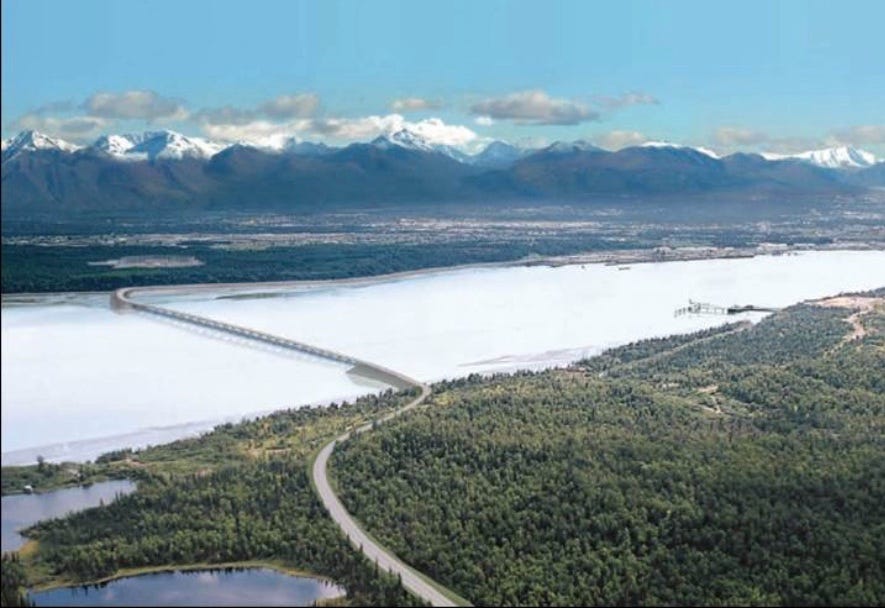
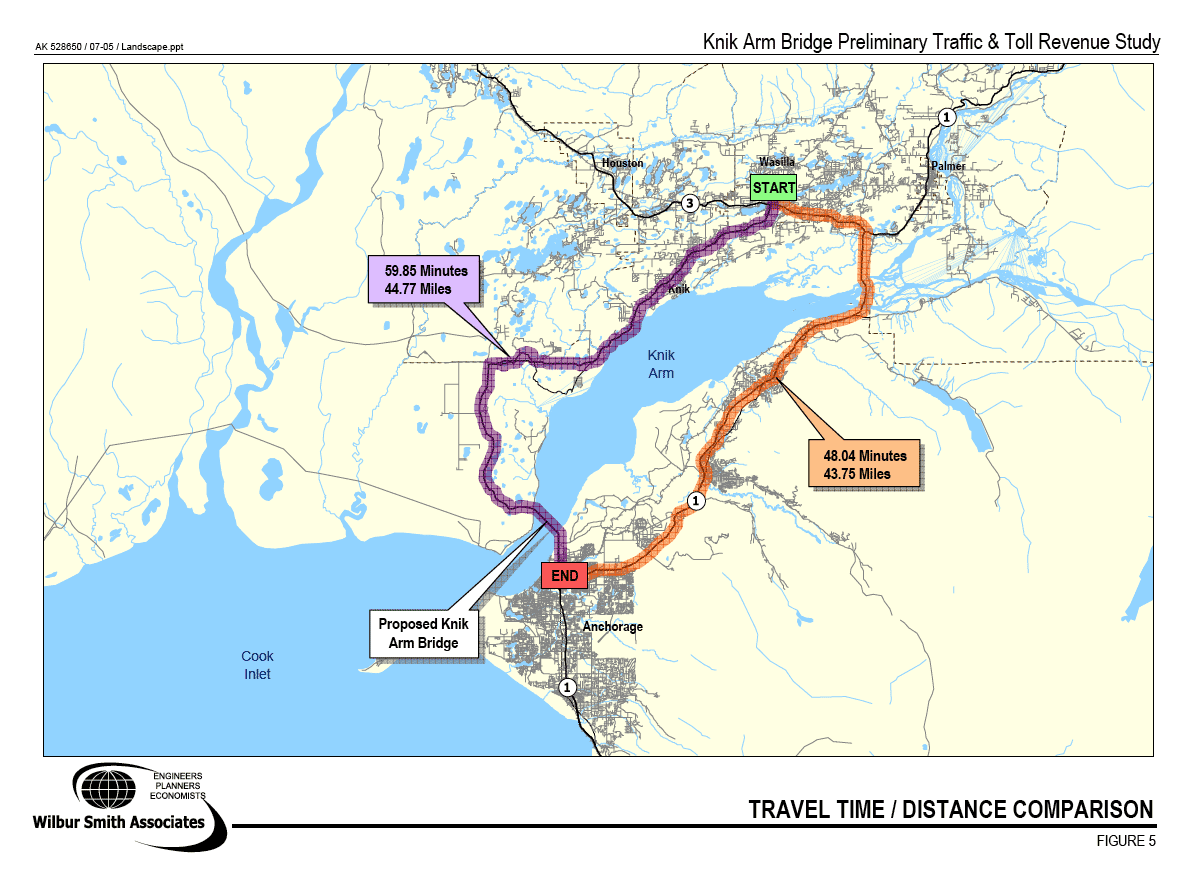
Point MacKenzie is a broad peninsula in the Matanuska-Susitna Borough, situated on the western shore of Knik Arm - the narrow northern branch of Cook Inlet that separates it from Anchorage. By water, downtown Anchorage is barely two miles away. By road, it’s a 40-plus mile drive around the Arm, north through the Mat-Su Valley, and back down into Anchorage via the Glenn Highway.
That single geographic fact - two miles as the crow flies, forty miles by car - is essentially the entire investment thesis in one sentence.
Point MacKenzie currently hosts a patchwork of land uses. Port MacKenzie, a 14-square-mile commercial and industrial development managed by the Mat-Su Borough, sits on its eastern shore and is quietly becoming one of the most strategically significant deep-water ports in the state. The Goose Creek Correctional Center, one of Alaska’s largest facilities, is located there. The University of Alaska’s former Agricultural Experiment Station - since subdivided and sold to farmers - covers a significant area. Beyond that, there is raw land: boreal forest, wetlands, and lightly developed acreage that stretches toward the tip of the peninsula, where a handful of private parcels sit overlooking Cook Inlet with views of the Chugach Mountains and, on a clear day, the Alaska Range.
In short: Point MacKenzie is not nothing. It already has real infrastructure, real institutions, and a real industrial port. What it lacks is a direct connection to Anchorage - the economic engine that would transform it from a functional backwater into something else entirely.
That connection has been debated, studied, funded, defunded, and debated again for over two decades. And in the last eighteen months, it has come back to life in a meaningful way.
Twenty Years of “The Bridge”: A History You Need to Know
If you’re going to invest in Point MacKenzie, you need to understand why “the bridge” carries so much baggage - because the history of the Knik Arm Crossing is both the best argument for buying land there and the most cautionary tale you’ll ever hear about government infrastructure in Alaska.
The story begins in earnest in 2003, when the Alaska Legislature created the Knik Arm Bridge and Toll Authority, known as KABATA, to develop a plan for constructing a crossing between Anchorage and Point MacKenzie. The logic was straightforward: a bridge would open up tens of thousands of acres of developable land, provide a critical redundancy to the Glenn Highway - which runs through a narrow corridor between Chugach State Park and Joint Base Elmendorf-Richardson - and give Mat-Su residents a second route into Anchorage.
For several years, the project made meaningful progress. A Record of Decision was obtained from the Federal Highway Administration. Environmental impact statements were completed. In 2005, U.S. Senator Ted Stevens secured a $231 million Congressional earmark for the bridge - though the earmark was later stripped after it became entangled in the national “bridges to nowhere” controversy alongside the infamous Gravina Island Bridge in Ketchikan.
By 2010, after over $53 million had been spent on studies, preliminary designs, public relations, and cost estimating, the FHWA issued a formal Record of Decision accepting the project’s Environmental Impact Statement. The bridge appeared to be moving forward.
Then the math started catching up with the enthusiasm.
Revenue projections had been built on population growth forecasts that turned out to be as much as 50% higher than what actually materialized. Toll revenue models looked increasingly shaky. Costs climbed. In 2016, Governor Bill Walker axed the project along with two other major infrastructure initiatives, citing fiscal constraints as the state dealt with cratering oil revenues. By that point, Alaska had spent over $100 million on a bridge that remained stubbornly unbuilt.
Governor Mike Dunleavy reversed Walker’s administrative order in 2019, and the project was technically resurrected. But without funding, resurrection amounted to little more than bureaucratic breathing. The project has not meaningfully advanced since.
For land investors, this history should not be merely discouraging - it should be instructive. The bridge was never killed because anyone decided it was a bad idea. It was killed because the financing never worked, the political will evaporated, and the timing was off. The underlying logic - that Anchorage and Point MacKenzie are separated by an absurdly small body of water - has never been refuted. Neither has the underlying demand: the Mat-Su Borough remains the fastest-growing region in Alaska, and the Glenn Highway remains a single-point-of-failure corridor for the state’s most populous region.
The Tunnel Study: A New Chapter
Here’s where things get genuinely interesting.
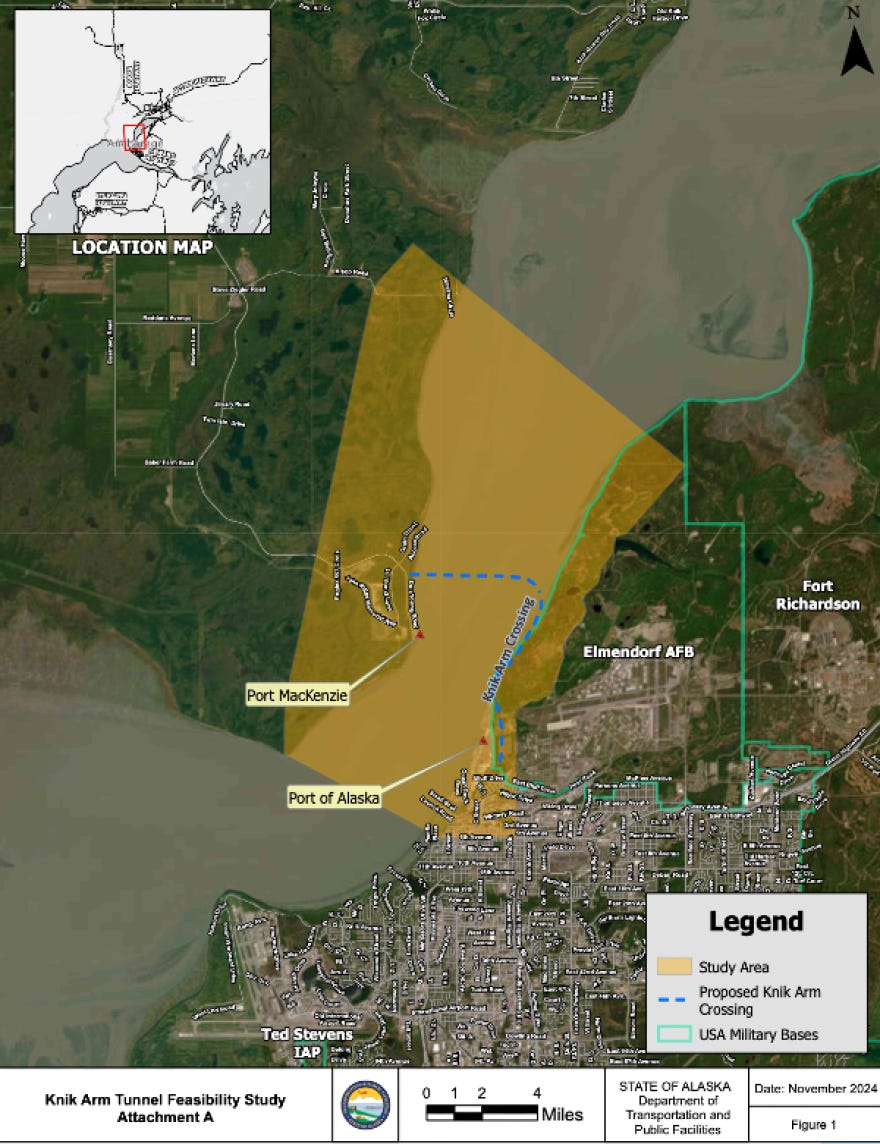
In November 2024, the Alaska Department of Transportation announced it would spend $1 million on a feasibility study for a tunnel beneath Knik Arm - a potential alternative to the long-proposed bridge. The tunnel would connect an undeveloped area of Anchorage with Point MacKenzie, and the feasibility study is specifically designed to examine costs, potential economic benefits, and environmental impacts.
The study was expected to be completed by December 2025.
This is not the same as announcing a tunnel will be built. Let’s be clear about that. Alaska has a long and distinguished history of commissioning feasibility studies that lead to other feasibility studies. But the tunnel study represents something important: sustained institutional attention to the Knik Arm crossing problem, now being approached from a different engineering angle.
Why a tunnel rather than a bridge? The bridge faced legitimate opposition on multiple fronts. Government Hill residents in Anchorage objected strenuously to approaches that would bisect their neighborhood. Environmental groups raised concerns about Cook Inlet beluga whales, an endangered population that uses the waters of Knik Arm. And the sheer visual and physical footprint of a 2-mile overwater bridge carries a different political weight than an underground crossing that leaves the surface largely undisturbed.
A tunnel sidesteps most of those objections. It’s not without its own challenges - underground construction through tidal geography involves complex engineering and significant cost - but the conceptual appeal is real.
Meanwhile, the fundamental driver of demand continues to grow stronger. Approximately one-third of Mat-Su residents currently commute to Anchorage for work. That commute runs along the Glenn Highway - a road that has proven its vulnerability repeatedly. A 2018 truck collision closed southbound lanes for hours, trapping thousands of drivers. The November 2018 earthquake damaged multiple bridges along the highway corridor. The state’s military installations, food supply chains, fuel logistics, and medical infrastructure all flow through the same narrow geographic bottleneck.
Senator Mike Shower of Wasilla, an outspoken advocate for the crossing, has framed this as a matter of basic infrastructure resilience: “The Glenn Highway is critical for the military and to truck food, fuel and medicines north of Anchorage. But backups are needed.”
He’s not wrong. And when the political calculus around infrastructure resilience is this clear, the question is never really if - it’s when.
Port MacKenzie: The Anchor Asset Most Investors Overlook
Most conversations about Point MacKenzie fixate on the bridge or tunnel. What they undersell is the degree to which Port MacKenzie has already become a legitimate economic anchor - independently of any crossing.
Port MacKenzie is a deep-draft port on Knik Arm, capable of handling large cargo vessels. Unlike the Port of Anchorage, which sits in the middle of the municipality and faces significant constraints around expansion, Port MacKenzie sits in a borough with substantial undeveloped land and far fewer competing claims on its surroundings.
In 2024, the U.S. Department of Transportation awarded a $7.9 million federal grant for a new barge ramp at Port MacKenzie - infrastructure that expands its capacity for cargo and bulk materials. An $8 million barge ramp construction project was already in the pipeline. The port has been steadily adding facilities and attracting new customers, with port director Dave Griffin regularly updating the Mat-Su Borough Assembly on incremental but meaningful progress.
There are also plans, at various stages of development, for a rail extension to Port MacKenzie. The Alaska Railroad already extends its network into the Mat-Su Borough, and a spur to the port would give mining and timber industries a direct export route that bypasses road transportation entirely. For bulk commodities - coal, minerals, timber, aggregate - rail access to a deep-water port is a transformational economic asset.
Additionally, there has been serious discussion of a 100-mile road corridor through the backcountry to provide access to a large gold mine in the Western Susitna Valley. If that road is built, it would route through Point MacKenzie area, making the port an export terminus for a mining operation that could be one of the largest in the state.
None of these individual projects is guaranteed. But when you see a port receiving federal investment, a railroad planning a spur, a mining road under discussion, and a borough actively developing a townsite master plan - all converging on the same geography - you’re looking at a confluence of catalysts that rarely stays dormant indefinitely.
The Mat-Su Growth Story: Alaska’s Sun Belt
The Matanuska-Susitna Borough is, by almost any measure, Alaska’s growth engine. It’s the fastest-growing region in the state. Over 60% of Alaska’s total population lives in the combined Anchorage-Mat-Su area, comprising what is by far the state’s largest and most dynamic regional economy. Palmer and Wasilla have evolved from farming and railroad towns into suburban communities with real commercial infrastructure, healthcare systems, schools, and expanding retail.
The paradox of Mat-Su growth is that much of it is happening at considerable commuting distance from Anchorage, the city where a large share of residents actually work. As Anchorage’s buildable land within the municipality becomes increasingly constrained - hemmed in by military bases, state parks, Chugach State Park, and the inlet itself - growth naturally seeks the Mat-Su. But that growth is being forced through the single corridor of the Glenn Highway, creating both congestion problems and resilience risks.
Point MacKenzie represents the most dramatic near-term solution to that constraint. It sits just across the water from downtown Anchorage, in a borough where land is still affordable, regulation is still flexible, and infrastructure investment is finally catching up with demand. The Mat-Su Borough Assembly has already created the Point MacKenzie Townsite through formal resolution, identifying approximately three square miles of borough-owned land along Alsop Road adjacent to Port MacKenzie as the nucleus of a planned community.
The Borough’s own language is worth reading directly: they envision Point MacKenzie becoming “a full-fledged gateway city to the bountiful opportunities available in the Alaskan Interior. A city with attractive neighborhoods where people can live locally and feel part of a vibrant community. A city that attracts and supports a variety of residents, activities, and economic opportunities.”
That’s not just boosterism. It’s a legally enacted planning framework backed by an Assembly resolution, a form-based development code, and ongoing multi-department collaboration. The Borough is not waiting for the bridge - they are actively building the institutional infrastructure of a city in anticipation of the crossing that will make it viable.
The Investment Case: What You’re Actually Buying
So what does a land investment in Point MacKenzie actually look like?
The market is thin and fragmented. Current listings on platforms like Redfin show around 14 to 18 active land parcels in the Point MacKenzie area, with a median listing price around $650,000. Individual parcel sizes vary enormously - from sub-acre lots at the peninsula’s tip with inlet views, to agricultural tracts, to raw acreage in the interior.
There are a few distinct categories of opportunity:
Residential/Mixed-Use Parcels in the Townsite Area
The Borough’s townsite designation along Alsop Road represents the highest-probability zone for future urban development. These parcels sit closest to Port MacKenzie and would be the first to benefit from planned utility extensions, road improvements, and eventually the density that a bridge or tunnel would bring. Buying here is essentially a bet on the townsite master plan materializing - which carries meaningful risk but also the most direct exposure to upside if the crossing happens.
Port-Adjacent Industrial Land
As Port MacKenzie expands its barge and cargo operations, demand for industrial staging, warehousing, and logistics space in the immediate port area will grow - independently of any bridge. This is arguably the lower-risk play: you’re buying into an asset class (industrial port-adjacent land) that is already generating real demand, with the crossing as optionality rather than the primary thesis.
Waterfront and Tip-of-Peninsula Parcels
These are the most speculative but arguably the most visually compelling: parcels at the tip of Point MacKenzie with views across Cook Inlet to the Chugach Mountains. Currently accessible only by water, ATV, or snowmachine from borough-maintained roads, these have limited current utility but extraordinary scenery. Think of these as the equivalent of buying undeveloped waterfront before a road is built - illiquid, scenic, and dependent on long-horizon catalysts.
Agricultural Land
The former University of Alaska Agricultural Experiment Station parcels have been subdivided and sold to farmers, and agricultural land in the area generally trades on different fundamentals than the development plays. For the right buyer, these offer a productive underlying use case while maintaining optionality on future rezoning or development.
The Honest Risk Assessment
Any serious treatment of this opportunity has to grapple with the risks, and they are substantial.
The Crossing May Not Happen
This is the central risk, and it deserves to be stated plainly. The Knik Arm crossing - whether bridge or tunnel - has been studied for over 20 years and has been defunded, cancelled, and relegated to dormancy multiple times. The state faces structural budget challenges linked to oil revenue volatility. Federal transportation funding is competitive and uncertain. Political opposition from Anchorage residents (particularly in Government Hill, whose neighborhood would be bisected by some bridge configurations) remains real. If the crossing never happens, or doesn’t happen for another 30 years, Point MacKenzie land values will remain deeply depressed outside of the industrial port area.
Infrastructure Chicken-and-Egg Problems
Even with a crossing, Point MacKenzie currently lacks the utility infrastructure -water, sewer, electrical grid - that would support dense residential or commercial development. Building that infrastructure requires either the Borough to invest public funds or developers to bear the cost themselves, which typically requires a density of demand that doesn’t yet exist. The townsite plan addresses this conceptually, but execution requires both political will and capital that aren’t guaranteed.
Environmental Constraints
Knik Arm’s tidal mudflats, the endangered Cook Inlet beluga whale population, and Alaska’s complex permitting landscape for development near sensitive marine habitats create real friction for both the crossing and adjacent development. The beluga population has been in long-term decline, and any project in the Knik Arm corridor will face heightened environmental scrutiny.
Liquidity Risk
Point MacKenzie land is illiquid. The market is thin, buyers are scarce, and holding periods will be measured in years or decades. If you need to exit quickly, you almost certainly won’t be able to at a price that works. This is not a position for capital you can’t afford to have locked up for an extended and uncertain period.
Alaska’s Broader Economic Volatility
Alaska’s economy remains heavily tied to oil revenue, and the state’s fiscal position has been challenged for years. Economic downturns hit Alaska’s real estate harder than most markets. A recession, an extended oil price collapse, or a major federal policy change affecting Alaskan resource development could suppress Mat-Su land values broadly, regardless of what happens with the crossing.
The Historical Parallel: Other “Bridge to Nowhere” Land Plays
History offers a useful frame here.
The derisive label “bridge to nowhere” has been applied to the Knik Arm project. But consider how often infrastructure projects that were once derided as unnecessary or premature eventually happened - and what happened to land values in the zones they served.
The growth of the American Sunbelt is, in large part, a story of infrastructure enabling density where density was previously impossible. Interstate highway extensions that looked like overbuilding in 1970 became the arteries of sprawling metro areas by 1995. The skeptics were often right about timing. They were rarely right about direction.
The specific comparison I’d draw is to any number of suburban land plays that sat dormant for a decade or two before a highway interchange or bridge made them suddenly accessible. The pattern is consistent: land prices in the zone of infrastructure impact remain relatively flat during the planning and political uncertainty phase, then move sharply once construction begins or is definitively committed. By the time ground is broken, much of the easy money has been made by the patient holders who bought during the uncertainty.
That is precisely where Point MacKenzie sits today: in the uncertainty phase, with a non-trivial probability of a crossing finally happening in the next decade, and with land still priced as if the crossing will never come.
What the Smart Money Is Watching
If you’re interested in tracking the Point MacKenzie situation without committing capital, here are the specific catalysts worth monitoring:
The Knik Arm tunnel feasibility study, commissioned by the Alaska DOT in late 2024 and due for completion by late 2025, is the immediate watchpoint. A favorable feasibility finding would be a meaningful signal that the tunnel concept has legs - and would likely trigger another round of environmental review and financing studies. Each completed milestone in that chain makes the eventual project more likely and reduces the optionality discount embedded in Point MacKenzie land prices.
Federal infrastructure funding cycles are a critical watch point. The 2021 Infrastructure Investment and Jobs Act created significant new funding streams for transportation projects, and Alaska’s Congressional delegation - historically skilled at securing federal transportation dollars - has been attentive to the Knik Arm corridor. A federal commitment to funding studies or initial construction would be transformative.
Port MacKenzie’s continued development is an independent signal worth tracking. Each new federal grant, each new barge facility, each new industrial customer at the port strengthens the case for Point MacKenzie as an economic zone independent of the residential development thesis. Port growth is the rising floor; the crossing is the upside scenario.
The Mat-Su Borough’s townsite planning progress is also worth following closely. If the Borough continues to invest in detailed planning, utility studies, and development code refinement for the Point MacKenzie Townsite, it signals sustained institutional commitment to making the area viable. If that planning activity stalls or is deprioritized, it’s a warning sign.
The Bottom Line
Point MacKenzie is not for the impatient investor. It is not a trade. It is not something you buy expecting a flip in eighteen months.
What it is: a long-horizon land play in a geography with an almost uniquely compelling fundamental constraint - two miles of water separating undeveloped land from a growing city - and a slowly accumulating body of evidence that the crossing connecting them will eventually get built.
The crossing has been studied, funded, defunded, resurrected, and studied again. The tunnel feasibility study represents the latest iteration of a process that has been moving forward, however haltingly, for over two decades. Port MacKenzie is growing independently. The Mat-Su Borough is actively planning. The Glenn Highway remains a single-point-of-failure corridor for Alaska’s most important regional economy.
At some point, the pressure of geography and economics wins. It usually does.
The question for the investor is whether you can hold through the uncertainty and whether you can stomach the very real possibility that the certainty never fully arrives on your timeline.
For those who can answer both questions honestly, Point MacKenzie may be the most overlooked land opportunity in the United States right now. It sits two miles from a major American city. It has a port, a planning framework, and twenty years of infrastructure momentum behind it. And it’s still priced like a remote Alaskan backwater, because that’s essentially what it still is.
For now.